What Is SAP Software? The Complete Guide
From a five-person startup in 1972 to the backbone of the global economy — SAP is the enterprise software that quietly runs the world’s largest organizations.
What Does SAP Stand For?
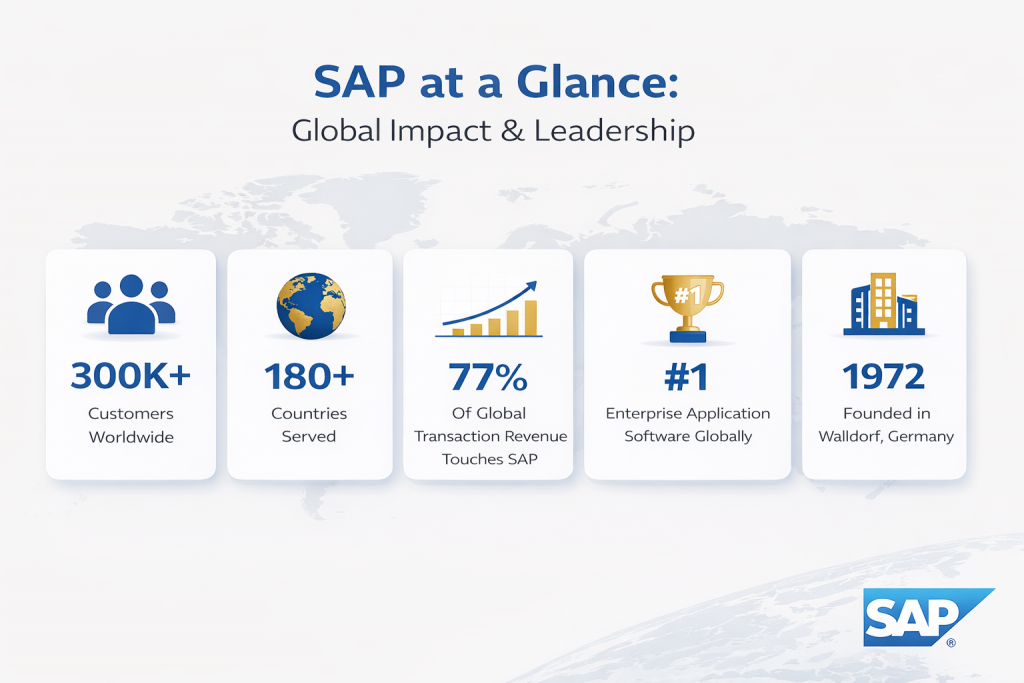
SAP stands for Systeme, Anwendungen und Produkte in der Datenverarbeitung — German for “Systems, Applications, and Products in Data Processing.” The company was founded in 1972 by five former IBM engineers in Mannheim, Germany, with a singular vision: to develop a standard software application that could process business data in real time.
Today, SAP SE is headquartered in Walldorf, Germany, and is the largest non-American software company in the world by revenue. It is listed on the Frankfurt Stock Exchange and the New York Stock Exchange.
What Exactly Is SAP Software?
At its core, SAP is an Enterprise Resource Planning (ERP) system — a type of software that integrates all the core business processes of an organization into a single unified system. Think of it as the central nervous system of a company: finance, supply chain, human resources, manufacturing, procurement, sales, and more all share the same database and speak the same language in real time.
“Before ERP systems like SAP, companies ran on dozens of isolated, incompatible systems. Finance didn’t talk to logistics. Warehouses didn’t know what sales had promised. SAP changed all of that.”
Instead of having a separate payroll system, a separate inventory tracker, and a separate customer database — all requiring manual reconciliation — SAP connects every department into a single source of truth. When a sale is made, inventory updates automatically. When materials are consumed in manufacturing, procurement is triggered. When an employee is hired, payroll is configured. Everything happens in one integrated ecosystem.
Core SAP Modules Explained
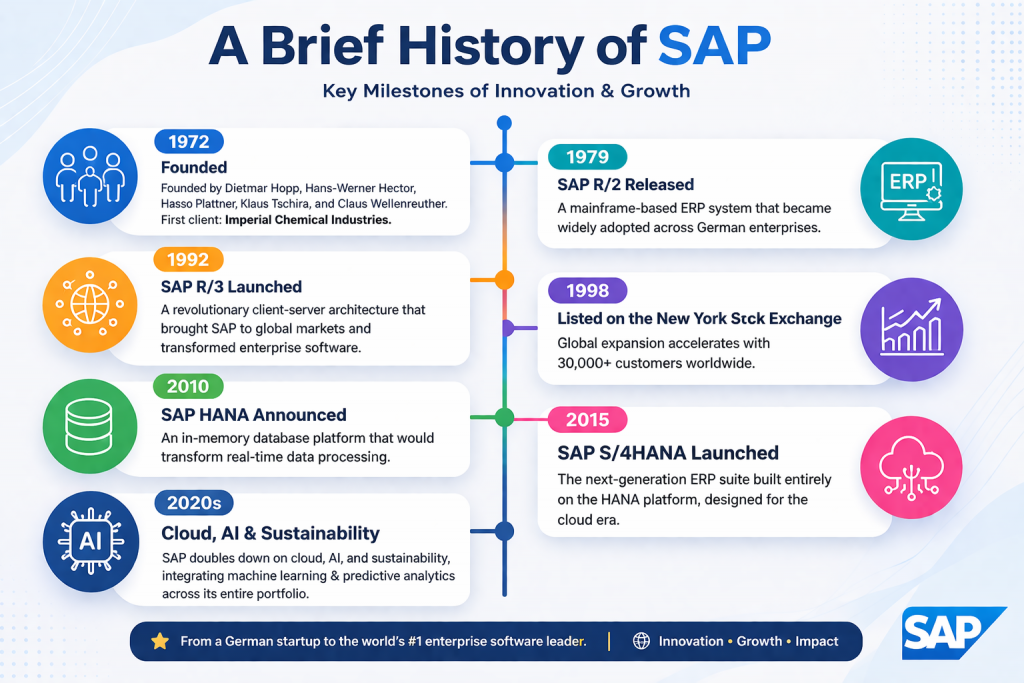
SAP is not a single product but a suite of integrated modules, each addressing a specific business function. Organizations implement the modules relevant to their needs.
SAP S/4HANA — The Modern Core
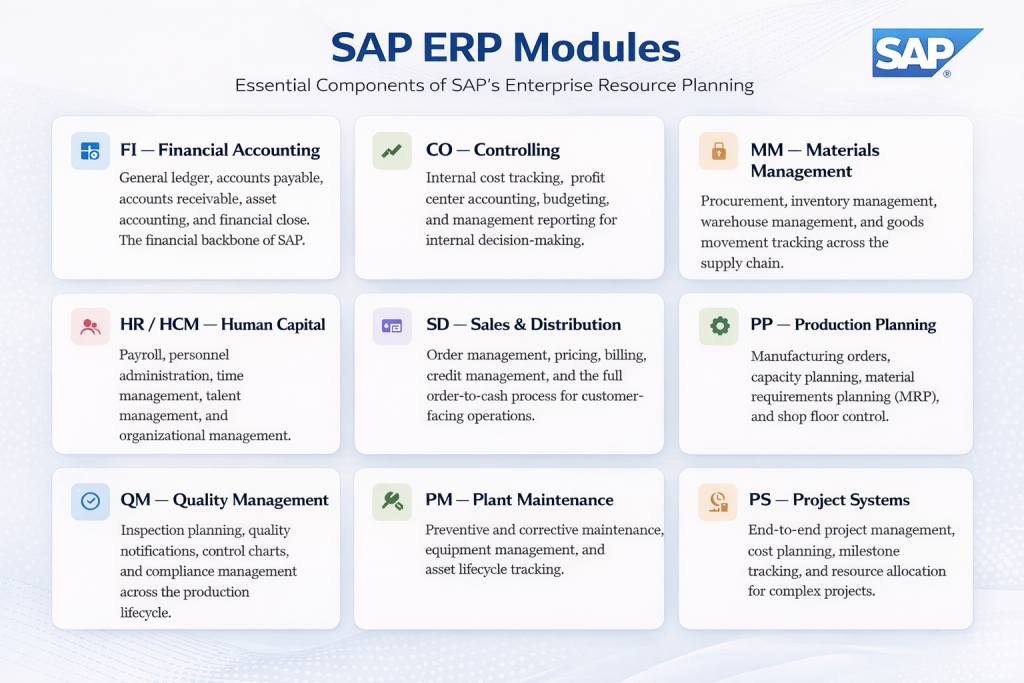
SAP S/4HANA is the current flagship ERP system from SAP, launched in 2015. Built on the SAP HANA in-memory database, it processes enormous volumes of data in real time — dramatically faster than its predecessor, SAP ECC (ERP Central Component).
S/4HANA comes in three deployment options: on-premise (installed on company servers), cloud (hosted and managed by SAP), and hybrid (a combination of both). The cloud version is increasingly popular for mid-market companies, while large enterprises often opt for on-premise or hybrid deployments to maintain control over customization.
Key features of S/4HANA include a simplified data model (reducing database sizes by up to 10x), an intuitive Fiori user interface, embedded analytics with real-time insights, and built-in AI and machine learning capabilities that can predict cash flow, detect anomalies, and automate repetitive tasks.
Industries That Use SAP
SAP is not limited to any single vertical — it serves virtually every major industry with specialized solutions tailored to sector-specific requirements.
- Manufacturing
- Retail & Consumer Goods
- Banking & Financial Services
- Healthcare & Life Sciences
- Oil, Gas & Energy
- Public Sector & Government
- Automotive
- Telecommunications
- Utilities
- Defense & Security
- Higher Education
- Mining & Metals
- Hospitality & Travel
- Chemicals
- Agriculture
Companies like Apple, Coca-Cola, BMW, Nestlé, Shell, Walmart, and thousands of governments rely on SAP to run their core operations. When you buy a Coca-Cola, the sale, inventory deduction, and financial recording likely all happened inside SAP in seconds.
Key Benefits of SAP
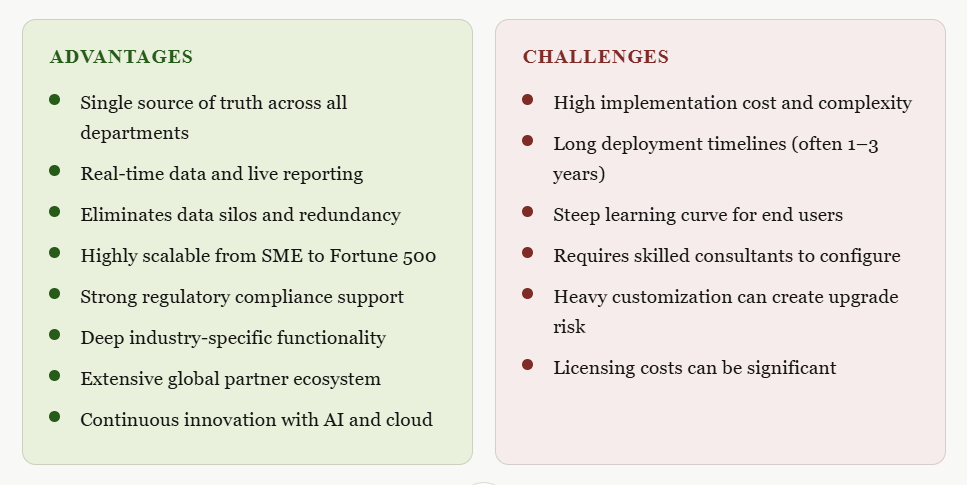
SAP vs Other ERP Systems
SAP competes primarily with Oracle ERP (and Oracle NetSuite for mid-market), Microsoft Dynamics 365, and Infor. SAP’s strength lies in its breadth and depth — no other vendor matches its coverage of complex, global, large-enterprise scenarios. Oracle is SAP’s closest rival in the upper enterprise segment, while Microsoft Dynamics dominates the mid-market with a lower total cost of ownership.
For small businesses, cloud-native alternatives like NetSuite, Odoo, or Sage may offer better value. SAP’s Business One and Business ByDesign products target the SME market, though they lack the full depth of S/4HANA.
SAP Careers & the Job Market
SAP skills are among the most in-demand in enterprise IT. Functional consultants (who configure SAP to match business processes) and technical consultants (ABAP developers, BASIS administrators, Fiori developers) command strong salaries globally. Typical roles include SAP Functional Consultant, SAP Technical Consultant, SAP Project Manager, SAP Solution Architect, SAP Basis Administrator, and SAP Data Analyst.
SAP offers official certification programs through its SAP Learning Hub, ranging from associate-level certificates to professional and specialist designations. Certifications in S/4HANA Finance, SAP HANA, and SAP BTP (Business Technology Platform) are particularly valued in 2026.
SAP Business Technology Platform (BTP)
Beyond traditional ERP, SAP has built the SAP Business Technology Platform (BTP) — a unified platform that combines database and data management, analytics, application development, integration, and intelligent technologies under one roof. BTP allows businesses to extend SAP applications, build custom apps, integrate third-party systems, and leverage SAP’s AI capabilities without deep customization of the core ERP system.
This “clean core” approach — keeping the ERP standard while extending via BTP — is now SAP’s recommended architecture for modern implementations, making upgrades far less painful and cloud transitions smoother.
Frequently Asked Questions (FAQs):
SAP software is used to manage and integrate a company’s core business processes — including finance, accounting, human resources, supply chain, procurement, manufacturing, and sales — in a single unified system. Instead of running separate tools for each department, SAP acts as one central platform where all data is connected and updated in real time. It is used by businesses of all sizes, from mid-market companies to the world’s largest enterprises, across virtually every industry.
SAP has a steep learning curve for beginners because of its vast scope and complexity. However, it is entirely learnable with structured training. SAP offers official courses and certifications through its SAP Learning Hub, and there are thousands of third-party training resources available. Most professionals specialize in one or two SAP modules (such as SAP FI for finance or SAP MM for procurement) rather than the entire system. With consistent practice, beginners typically become job-ready in 3–6 months of focused study.
SAP ECC (ERP Central Component) is the older, widely deployed version of SAP’s ERP system, while SAP S/4HANA is the modern next-generation platform launched in 2015. The key differences are: S/4HANA runs on the in-memory SAP HANA database (making it significantly faster), it has a simplified data model that reduces database size by up to 10x, it features the modern Fiori user interface, and it includes embedded AI and real-time analytics. SAP has announced that mainstream maintenance for ECC will end in 2027, making migration to S/4HANA a priority for most organizations.
SAP pricing varies greatly depending on the deployment model, number of users, and modules required. Licensing fees typically range from $1,500 to $3,500 per named user for on-premise deployments, while cloud subscriptions are priced annually per user. Beyond licensing, implementation costs — which include consulting, customization, data migration, and training — often represent the largest expense, frequently running from $300,000 for small deployments to several million dollars for large enterprise rollouts. SAP’s Business One product offers a more affordable entry point for small businesses.