
SAP Business One for Transportation Management
Quick Summary
SAP Business One for Transportation Management is an integrated ERP solution designed specifically for small and mid-sized enterprises (SMEs) in the transport and logistics industry. It unifies fleet management, route optimization, inventory tracking, billing automation, and real-time reporting into one centralized platform — eliminating operational silos, reducing costs, and enabling data-driven decisions. Whether you run a trucking company, a freight forwarder, or a last-mile delivery service, SAP Business One delivers enterprise-grade tools scaled for your business size.
What Is SAP Business One?
SAP Business One is a comprehensive enterprise resource planning (ERP) software developed by SAP SE, one of the world’s largest software companies. Unlike SAP’s flagship S/4HANA suite designed for large corporations, SAP Business One is purpose-built for small and medium-sized enterprises (SMEs) — offering the same depth of functionality at a fraction of the complexity and cost.
At its core, SAP Business One integrates all major business functions — finance, sales, purchasing, inventory, production, and customer relationship management — into a single, unified system. For transportation and logistics companies, it provides a purpose-fit environment to manage the unique demands of moving goods, tracking fleets, optimizing routes, and maintaining compliance.
Definition: An ERP (Enterprise Resource Planning) system is software that centralizes and automates core
business processes, allowing different departments to share accurate, real-time data from a single source.
The Role of SAP Business One in Transportation Management
Transportation management involves far more than simply moving goods from Point A to Point B. It encompasses fleet scheduling, driver management, freight costing, customer billing, regulatory compliance, and real-time visibility across the supply chain. Managing all of this through disconnected spreadsheets, legacy software, or manual processes leads to errors, delays, and lost revenue.
SAP Business One acts as the operational backbone for transport businesses by:
- Centralizing all operational data — from dispatch to delivery — in one platform
- Enabling real-time visibility into fleet location, cargo status, and delivery milestones
- Automating repetitive tasks such as invoicing, purchase orders, and compliance reports
- Providing actionable analytics through dashboards and customizable reports
- Connecting field operations with back-office finance and administration seamlessly
Key Features of SAP Business One for Transportation Management
Here is a detailed look at the core modules and features that make SAP Business One a leading logistics ERP for transport companies:
1. Fleet Management & Vehicle Tracking
SAP Business One integrates with GPS and telematics tools to give you real-time visibility into your entire fleet. You can:
- Monitor vehicle location, speed, and status from a centralized dashboard
- Schedule preventive maintenance and receive automated service alerts
- Track fuel consumption, mileage, and driver behavior to reduce operating costs
- Manage vehicle documentation including registrations, permits, and insurance
2. Route Planning & Optimization
Efficient route planning is critical for reducing fuel costs and meeting delivery SLAs. SAP Business One supports supply chain optimization through:
- Automated route assignment based on load, destination, and vehicle capacity
- Dynamic re-routing capabilities to respond to traffic, weather, or delays
- Multi-stop journey planning with optimized sequencing
- Integration with mapping and navigation APIs for real-world accuracy
3. Inventory & Warehouse Management
For transport companies that also manage warehouses or distribution centers, SAP Business One provides:
- Real-time stock levels with automated replenishment triggers
- Batch and serial number tracking for regulated or high-value cargo
- Multi-warehouse support with inter-branch transfers
- Barcode and RFID scanning for fast, accurate goods receipt and dispatch
4. Freight Billing & Financial Management
Transport business automation in billing eliminates manual errors and speeds up cash flow:
- Automated freight invoice generation based on delivered orders and agreed rates
- Multi-currency billing for international freight operators
- Customer statement management and overdue payment alerts
- Cost allocation per trip, route, or vehicle for accurate profitability analysis
5. Reporting, Analytics & Business Intelligence
Data-driven decision-making is a defining advantage of modern fleet management software:
- Customizable KPI dashboards for operations, finance, and senior management
- Profitability reports by customer, route, driver, or vehicle
- Compliance and audit-ready reporting for regulatory requirements
- SAP Crystal Reports and SAP Analytics Cloud integration for advanced BI
6. Benefits of SAP Business One for Transportation Companies
Companies that implement SAP Business One typically experience transformative results across operations, finance, and customer service:
| Benefit | What It Means for Your Business |
|---|---|
| Cost Reduction | Reduce fuel, maintenance, and administrative costs through automation and intelligent scheduling |
| Faster Invoicing | Eliminate billing delays with automated freight invoices generated at point of delivery |
| Improved Compliance | Stay audit-ready with built-in compliance tracking and regulatory document management |
| Better Customer Service | Provide clients with accurate ETAs, shipment tracking, and real-time status updates |
| Scalability | Add new routes, vehicles, or depots without changing your core ERP system |
| Unified Data | Break down data silos with one version of the truth across all departments |
Industry Use Cases: Who Benefits from SAP Business One?
SAP Business One’s flexible architecture means it delivers value across multiple sub-sectors of the transportation industry:
Road Freight & Trucking Companies
A mid-sized trucking company operating 50+ vehicles can use SAP Business One to centralize dispatch, automate load planning, and generate per-trip profit-and-loss reports. Real-world result: Reduced empty miles by 18% through better route scheduling and load consolidation.
Freight Forwarders & 3PL Providers
Third-party logistics providers managing multiple carrier relationships and client accounts benefit from SAP Business One’s multi-entity management and automated freight invoicing. It consolidates vendor bills, client invoices, and customs documentation in one place.
Last-Mile Delivery & Courier Services
E-commerce logistics providers and courier services use SAP Business One’s delivery
management and customer portal features to provide real-time package tracking, automate
proof-of-delivery workflows, and measure on-time delivery performance.
Cold Chain & Specialized Transport
Companies transporting perishable goods, pharmaceuticals, or hazardous materials can
leverage SAP Business One’s batch tracking, compliance documentation, and temperature
monitoring integration to maintain strict chain-of-custody records.
SAP Business One Implementation: A Step-by-Step Overview
Implementing a logistics ERP like SAP Business One is a structured process. Here is a simplified roadmap for transportation companies:
Step 1 – Business Requirement Analysis: Work with a certified SAP partner to document your current workflows, pain points, and goals. Define what processes need automation.
Step 2 – System Configuration & Customization: Configure SAP Business One modules (fleet, inventory, finance) to match your business processes. Add transportation-specific add-ons if required.
Step 3 – Data Migration: Import existing data including customer records, vehicle master data, open invoices, and inventory into the new system.
Step 4 – Integration Setup: Connect SAP Business One with GPS/telematics systems, ecommerce platforms, customs portals, or third-party logistics tools via APIs.
Step 5 – User Training: Train dispatchers, fleet managers, finance teams, and executives on their respective modules. SAP offers comprehensive training resources.
Step 6 – Go-Live & Support: Launch the system in a controlled go-live. Your SAP partner provides hypercare support during the first 30–90 days post-launch.
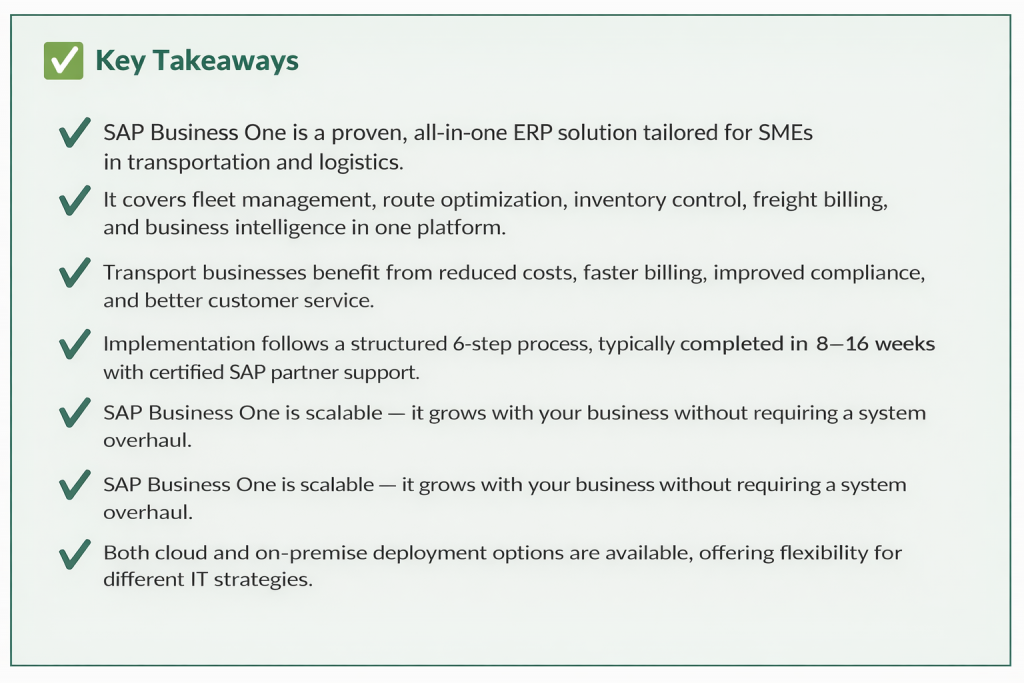
Typical implementation timelines for SMEs range from 8 to 16 weeks, depending on business complexity and customization requirements. Cloud deployment (SAP Business One Cloud) can significantly accelerate go-live timelines.
Common Challenges & How SAP Business One Addresses Them
Transportation companies often face recurring operational challenges. Here is how SAP Business One directly resolves them:
Challenge: Fragmented Systems | Solution: SAP Business One consolidates all data — dispatch, billing, HR, inventory — into one integrated platform, eliminating the need to switch between multiple tools.
Challenge: Manual Errors in Billing | Solution: Automated invoice generation from delivery confirmations ensures accurate, timely billing and eliminates human error in freight calculations.
Challenge: Poor Fleet Visibility | Solution: Real-time GPS integration and vehicle master data management provide fleet managers with a live operational picture at all times.
Challenge: Difficulty Scaling | Solution: SAP Business One’s modular design allows transport companies to add users, vehicles, and business entities without disrupting core operations.
Challenge: Compliance & Audit Risk | Solution: Built-in audit trails, document management, and financial controls ensure regulatory compliance and support easy internal and external audits.
Frequently Asked Questions (FAQ)
Yes. SAP Business One is specifically designed for small and mid-sized enterprises (SMEs). It is scalable, cost-effective compared to enterprise SAP suites, and can be deployed for companies with as few as 5 users. SAP partners also offer starter packages for growing transport businesses.
Pricing varies based on the number of users, deployment model (cloud vs on-premise), and required customizations. Generally, SAP Business One licensing starts from approximately $1,500–$3,000 per user for on-premise, with cloud subscriptions available from around $100– $150 per user per month. Contact a certified SAP partner for a tailored quote.
Absolutely. SAP Business One supports integration with leading telematics and GPS platforms through APIs and certified add-on solutions. This allows real-time vehicle location, driver performance data, and fuel usage to flow directly into your ERP system.
SAP TM (Transportation Management) is a standalone module within the larger SAP S/4HANA ecosystem, designed primarily for large enterprises with complex transportation networks. SAP Business One, in contrast, is an integrated ERP for SMEs that includes transportation management capabilities alongside finance, inventory, and CRM — making it a more practical and cost-efficient choice for smaller companies.
For most small to mid-sized transport companies, implementation takes between 8 and 16 weeks. Factors affecting the timeline include data migration complexity, the number of integrations required, and the level of customization needed. Cloud deployments tend to be faster than on-premise rollouts.
Yes. SAP Business One supports multi-currency, multi-language, and multi-entity operations. It complies with local tax and accounting regulations across 40+ countries, making it well-suited for international freight forwarders and cross-border transport operators.
SAP and its certified partner network provide ongoing support including system updates, user training, technical helpdesk, and business process consulting. Most partners offer annual maintenance contracts that cover bug fixes, regulatory updates, and access to new features.