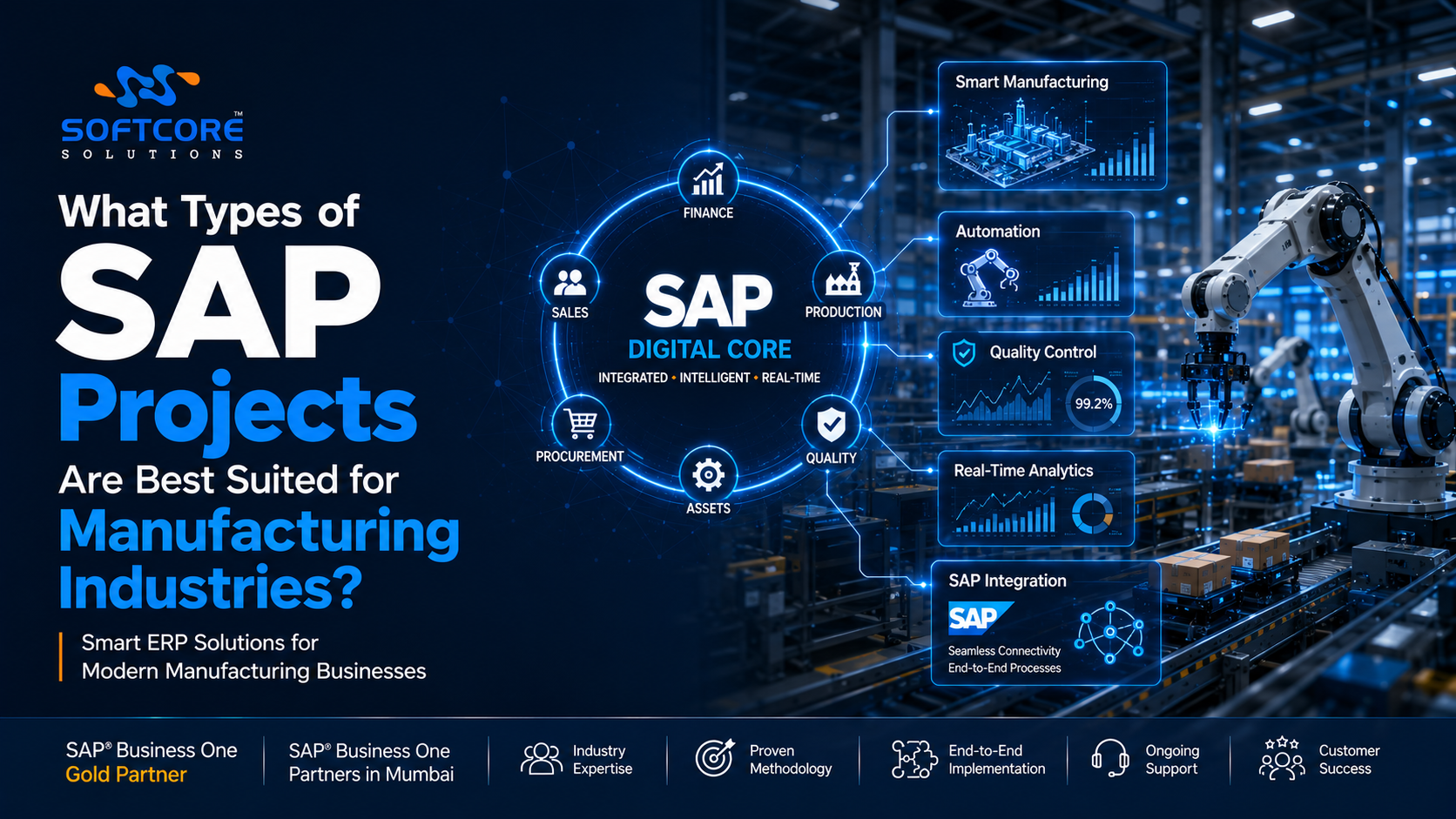
What Types of SAP Projects Are Best Suited for Manufacturing Industries?
Manufacturing industries today operate in an increasingly competitive and digitally connected environment. From raw material procurement to production scheduling, inventory control, warehouse management, quality assurance, and customer delivery, manufacturers must manage highly complex operations with speed and precision.
Unfortunately, many manufacturers still rely on disconnected software systems, spreadsheets, and manual processes that create operational inefficiencies, production delays, inventory inaccuracies, and rising operational costs. This is where modern manufacturing ERP solutions become essential.
As a trusted SoftCore Solutions and one of the leading SAP Business One Partners in Mumbai, the company helps manufacturers streamline business operations using intelligent ERP technologies tailored specifically for industrial and manufacturing environments.
Why Manufacturing Industries Need Specialized SAP ERP Projects
Manufacturing businesses have unique operational requirements compared to trading or service-based companies. They need ERP systems capable of handling:
- Production planning and scheduling
- Bill of Materials (BOM)
- Material Requirement Planning (MRP)
- Batch and serial number tracking
- Shop floor management
- Procurement automation
- Warehouse operations
- Quality inspections
- Costing and profitability analysis
- Supply chain coordination
Without an integrated ERP platform, manufacturers often struggle with:
- Inventory shortages or overstocking
- Production delays
- Lack of real-time visibility
- Poor demand forecasting
- Compliance challenges
- Manual reporting errors
- Inefficient warehouse operations
This is why SAP Business One for manufacturing has become one of the most preferred ERP solutions for SMEs and mid-sized manufacturers across India.
As an experienced SAP Business One Gold Partner Mumbai, SoftCore Solutions helps manufacturing companies implement industry-specific ERP projects that improve operational efficiency, reduce costs, and accelerate digital transformation in manufacturing.
Types of SAP Projects Best Suited for Manufacturing Industries
1. Production Planning & Control Projects
Production planning is one of the most critical ERP implementation areas for manufacturers. A well-designed production planning ERP system helps businesses optimize production schedules, reduce downtime, and improve resource utilization.
Key Features of Production Planning Projects
Bill of Materials (BOM) Management
BOM management enables manufacturers to define the complete structure of products, including:
- Raw materials
- Components
- Sub-assemblies
- Packaging materials
Using SAP manufacturing modules, manufacturers can maintain accurate BOM structures and eliminate material wastage.
Material Requirement Planning (MRP)
MRP helps businesses forecast material requirements based on:
- Sales orders
- Production demand
- Existing inventory
- Supplier lead times
This ensures uninterrupted production while minimizing excess stock.
Production Scheduling
SAP Business One helps manufacturers create intelligent production schedules based on:
- Machine availability
- Workforce capacity
- Material availability
- Delivery deadlines
This improves production efficiency and reduces operational bottlenecks.
Capacity Planning
Capacity planning ensures that production resources are utilized effectively without overloading machinery or labor resources.
Shop Floor Management
Manufacturers can track:
- Work-in-progress
- Machine utilization
- Production output
- Downtime analysis
- Real-time production tracking
Example
An automotive component manufacturer using SAP Business One for manufacturing can automate production scheduling, track machine capacity, and improve on-time delivery performance.
2. Inventory & Warehouse Management Projects
Inventory-related SAP projects are among the most valuable for manufacturing industries because inventory directly impacts working capital and operational continuity.
Key Features of Inventory Management SAP Business One Projects
Inventory Optimization
SAP helps businesses maintain optimal stock levels by automating:
- Reorder levels
- Safety stock calculations
- Demand forecasting
- Procurement planning
Batch & Serial Number Tracking
Especially useful for:
- Pharmaceutical manufacturing
- Food processing
- Chemical industries
Manufacturers can track product movement across the entire supply chain.
Barcode Integration
Barcode-based warehouse automation improves:
- Inventory accuracy
- Picking efficiency
- Goods receipt processes
- Dispatch management
Warehouse Automation SAP
Manufacturers can automate warehouse operations including:
- Bin management
- Stock transfers
- Cycle counting
- Real-time stock visibility
Real-Time Inventory Visibility
Using inventory management SAP Business One, management teams gain instant visibility into:
- Available stock
- Reserved inventory
- Production stock
- Dead stock
- Fast-moving inventory
Benefits
- Reduced inventory carrying costs
- Better warehouse efficiency
- Faster stock audits
- Improved order fulfillment accuracy
3. Supply Chain Management Projects
Modern manufacturing businesses require integrated supply chains to remain competitive.
Key Areas of Supply Chain Management SAP Projects
Vendor Management
SAP enables manufacturers to:
- Evaluate supplier performance
- Track vendor delivery timelines
- Manage procurement costs
- Improve supplier communication
Procurement Automation
ERP-driven procurement processes help automate:
- Purchase requisitions
- Purchase orders
- Vendor approvals
- Goods receipt processes
Demand Forecasting
Demand forecasting tools help manufacturers align production with market demand.
Logistics Coordination
Manufacturers can optimize:
- Transportation planning
- Delivery scheduling
- Shipment tracking
- Dispatch management
Supplier Performance Tracking
ERP analytics help identify:
- Delayed suppliers
- Cost variances
- Quality issues
- Procurement inefficiencies
Operational Benefits
- Reduced procurement delays
- Better supplier collaboration
- Improved supply chain visibility
- Lower operational costs
4. Quality Control & Compliance Projects
Quality management is crucial in manufacturing industries where regulatory compliance and product consistency directly affect customer trust and business reputation.
Key Components of Quality Control ERP Projects
Quality Inspection Workflows
SAP Business One enables manufacturers to create structured quality inspection processes for:
- Incoming raw materials
- Production stages
- Finished goods
Traceability
Manufacturers can trace products from raw material procurement to customer delivery.
This is critical for:
- Pharmaceuticals
- Food processing
- Chemical manufacturing
ISO Compliance
ERP systems help businesses maintain compliance with:
- ISO standards
- GMP requirements
- Industry regulations
Defect Management
Manufacturers can track:
- Rejected batches
- Production defects
- Root causes
- Corrective actions
Audit Readiness
ERP systems simplify audits through:
- Digital documentation
- Automated reporting
- Process traceability
Why It Matters
Strong quality control processes reduce:
- Product recalls
- Compliance penalties
- Customer complaints
- Production rework costs
5. Financial Management & Costing Projects
Financial visibility is one of the biggest advantages of ERP implementation for manufacturers.
Key Financial ERP Features
Production Costing
SAP Business One helps manufacturers calculate:
- Material costs
- Labor costs
- Machine costs
- Overhead allocation
Profitability Analysis
Businesses can analyze profitability by:
- Product line
- Customer
- Region
- Production batch
Budgeting & Forecasting
ERP tools help manufacturers create accurate budgets based on:
- Historical performance
- Production trends
- Sales forecasts
Financial Reporting
Real-time reporting helps management monitor:
- Cash flow
- Profit margins
- Operational expenses
- Inventory valuation
Cost Optimization
ERP insights help manufacturers identify areas for:
- Waste reduction
- Cost savings
- Process optimization
Benefits
- Better financial visibility
- Improved profitability
- Faster decision-making
- Accurate production costing
6. CRM & Customer Order Management Projects
Customer expectations in manufacturing industries are evolving rapidly. Manufacturers now require integrated CRM capabilities to improve customer satisfaction and order fulfillment efficiency.
Key CRM ERP Capabilities
Sales Order Management
SAP helps automate:
- Order processing
- Delivery scheduling
- Invoice generation
- Order tracking
Customer Relationship Management
Manufacturers can maintain complete customer histories including:
- Purchase behavior
- Service records
- Communication logs
Customer Forecasting
ERP analytics help businesses forecast future customer demand.
After-Sales Service
Manufacturers can manage:
- Warranty tracking
- Service requests
- Maintenance schedules
Benefits
- Improved customer experience
- Faster order processing
- Better customer retention
- Enhanced sales forecasting
7. Industry-Specific Manufacturing ERP Projects
Different industries require different ERP configurations.
Automotive Manufacturing ERP Projects
Focus Areas:
- Supplier coordination
- Just-in-time production
- Quality tracking
- Serial number management
Pharmaceutical Manufacturing ERP Projects
Focus Areas:
- Batch traceability
- Regulatory compliance
- Expiry tracking
- Quality inspections
Food Processing ERP Projects
Focus Areas:
- Batch management ERP
- Shelf-life tracking
- Recipe management
- Food safety compliance
Textile Manufacturing ERP Projects
Focus Areas:
- Dye lot tracking
- Production planning
- Inventory management
- Procurement automation
Chemical Manufacturing ERP Projects
Focus Areas:
- Formula management
- Hazardous material tracking
- Compliance reporting
Engineering Manufacturing ERP Projects
Focus Areas:
- Make-to-order manufacturing ERP
- Project costing
- BOM management
- Capacity planning
Benefits of SAP Business One for Manufacturing Industries
Implementing SAP Business One for manufacturing provides several operational and strategic advantages.
Major Benefits
Real-Time Business Visibility
Manufacturers gain access to real-time dashboards and analytics across departments.
Manufacturing Process Automation
ERP automation reduces manual work and improves operational accuracy.
Improved Production Efficiency
Production planning tools help reduce downtime and optimize resource utilization.
Better Inventory Management
Manufacturers can reduce excess inventory and avoid stock shortages.
Reduced Operational Costs
Automation and process optimization lower overall manufacturing expenses.
Faster Decision-Making
Real-time reports help management make data-driven business decisions.
Scalability
SAP Business One supports growing manufacturing businesses with scalable ERP capabilities.
Improved Customer Service
Better order management and delivery tracking enhance customer satisfaction.
Common Challenges During SAP Manufacturing Projects
While ERP implementation offers significant benefits, manufacturers may face challenges during deployment.
1. Data Migration Issues
Migrating historical data from legacy systems can be complex.
Solution
Conduct data cleansing before migration and use experienced SAP consultants.
2. Employee Resistance
Employees may resist process changes and ERP adoption.
Solution
Provide proper user training and involve teams early in the implementation process.
3. ERP Customization Challenges
Over-customization can increase implementation complexity.
Solution
Follow industry best practices and limit unnecessary customizations.
4. Timeline Management
Manufacturing ERP projects can face delays without proper planning.
Solution
Use phased implementation approaches with defined project milestones.
5. Integration with Existing Systems
Manufacturers often need ERP integration with machines, CRM systems, or third-party software.
Solution
Choose experienced SAP ERP consultants Mumbai with integration expertise.
Why Choose SoftCore Solutions as Your SAP Business One Partner in Mumbai
Choosing the right ERP implementation partner is critical for manufacturing success.
As one of the trusted SAP Business One Partners in Mumbai, SoftCore Solutions provides industry-focused ERP implementation services for manufacturers across India.
Why Manufacturers Choose SoftCore Solutions
SAP Business One Gold Partner Expertise
SoftCore Solutions delivers certified SAP implementation expertise tailored for manufacturing industries.
Manufacturing Industry Experience
The company understands the operational complexities of:
- Discrete manufacturing ERP
- Batch manufacturing ERP
- Make-to-order manufacturing ERP
Local Mumbai-Based Support
Manufacturers benefit from faster support and implementation assistance.
Customization Capabilities
The team provides industry-specific ERP customization for different manufacturing sectors.
Faster Deployment
Structured implementation methodologies help reduce deployment timelines.
Post-Go-Live Support
Manufacturers receive ongoing ERP optimization and support services.
Regulatory Understanding in India
SoftCore Solutions understands Indian taxation, compliance, and manufacturing reporting requirements.
Businesses looking for reliable manufacturing ERP experts India can benefit from tailored ERP implementation strategies aligned with operational goals.
Conclusion
Manufacturing industries today require intelligent, scalable, and fully integrated ERP systems to remain competitive in a rapidly evolving market.
From production planning and inventory management to supply chain coordination, quality control, and financial reporting, the right SAP projects for manufacturing industries can significantly improve operational efficiency and profitability.
SAP Business One for manufacturing enables manufacturers to automate processes, gain real-time visibility, reduce operational costs, and accelerate digital transformation in manufacturing.
However, successful ERP implementation depends heavily on choosing the right implementation partner.
As an experienced SAP Business One Gold Partner Mumbai, SoftCore Solutions helps manufacturing companies implement industry-specific ERP solutions tailored to their operational requirements.
If your manufacturing business is planning an ERP upgrade or digital transformation initiative, connect with SoftCore Solutions today for a customized SAP Business One consultation and discover how intelligent ERP solutions can transform your operations.
SAP Business One for manufacturing is an ERP solution designed to help manufacturers manage production, inventory, procurement, finance, quality control, and supply chain operations.
The cost depends on factors such as user count, customization, deployment type, and manufacturing complexity.
Most SME manufacturing ERP implementations take between 3 to 9 months depending on project scope.
Industries include automotive, pharmaceuticals, food processing, textiles, engineering, and chemical manufacturing.
Yes. SAP Business One supports batch tracking, expiry management, and lot traceability.
Yes. SAP Business One is highly suitable for SMEs looking for scalable and cost-effective manufacturing ERP solutions.
Yes. SAP supports barcode integration, warehouse automation SAP workflows, and inventory tracking systems.
Manufacturers typically achieve ROI through improved productivity, reduced inventory costs, better planning, and operational automation.
Local implementation partners provide faster support, manufacturing expertise, and better understanding of Indian compliance requirements.