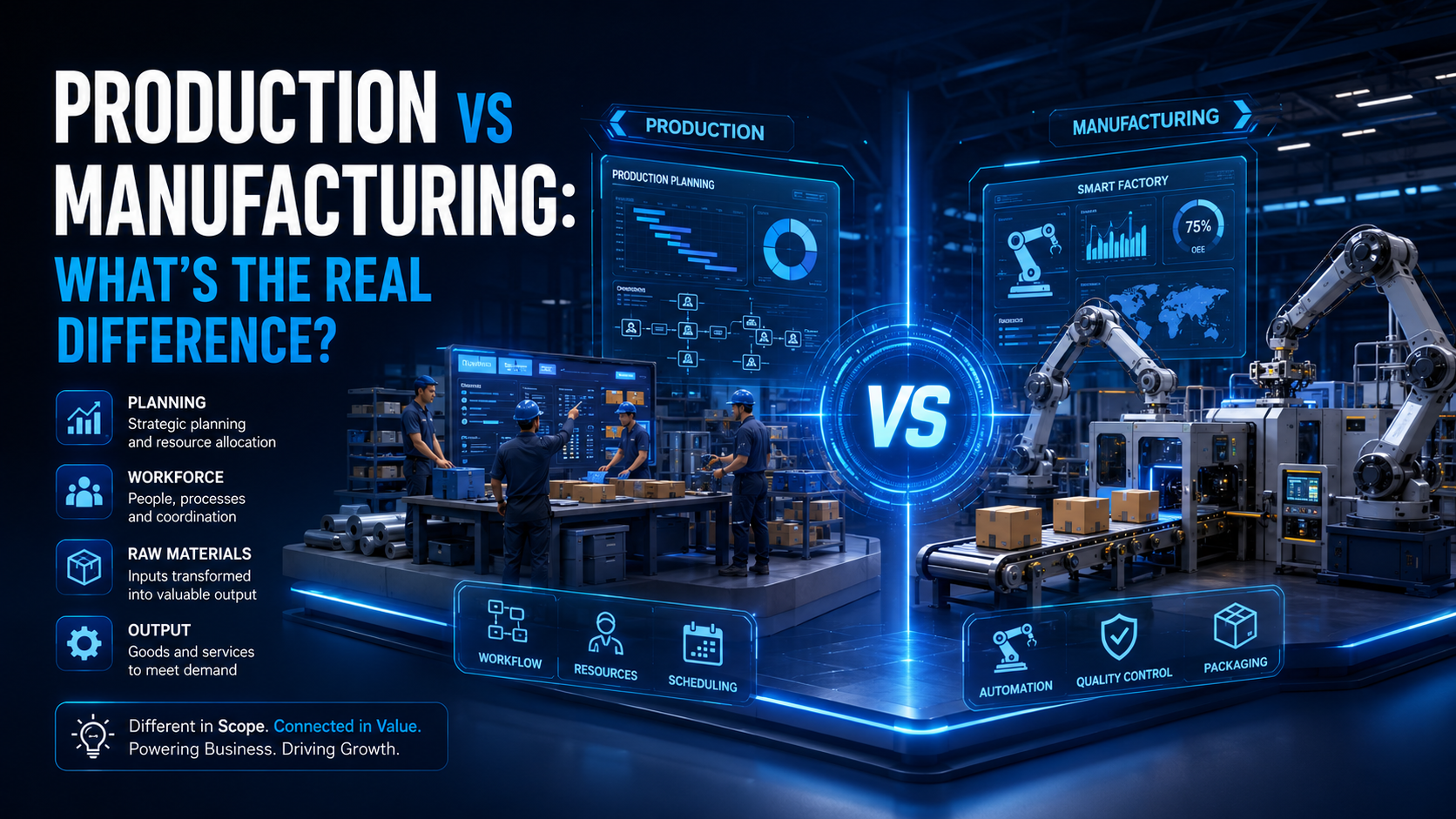
Production and Manufacturing Difference
Many people use the terms production and manufacturing as if they mean the same thing. While they are closely related, they are not identical. Understanding the production and manufacturing difference is important for businesses that want to improve operations, reduce costs, and scale efficiently.
In industries like automotive, electronics, food processing, engineering, and textiles, this distinction directly impacts planning, inventory control, automation, and ERP implementation. This is why growing businesses often work with experienced ERP consultants like Softcore Solutions to streamline manufacturing and production workflows using intelligent business software.
What is Production?
Production refers to the process of creating goods or services to meet customer demand. It involves transforming resources such as labor, raw materials, machinery, and technology into useful output.
Production is a broader concept because it includes both physical products and services.
Key Features of Production
- Broad operational activity
- Includes goods and services
- Can be manual or automated
- Focuses on value creation
- Uses available resources efficiently
Examples of Production
- Agriculture and farming
- Software development
- Electricity generation
- Food preparation
- Textile processing
In simple words, production is any activity that creates utility or economic value.
What is Manufacturing?
Manufacturing is a specific type of production where raw materials are converted into finished physical products using machinery, tools, labor, and industrial processes.
Unlike general production, manufacturing only deals with tangible products.
Key Features of Manufacturing
- Converts raw materials into finished goods
- Requires machinery and industrial processes
- Focuses on product quality and consistency
- Involves production planning and inventory control
- Supports large-scale output
Examples of Manufacturing
- Automobile assembly
- Mobile phone production
- Furniture manufacturing
- Steel fabrication
- Pharmaceutical production
Every manufacturing activity is production, but not every production activity is manufacturing.
Production and Manufacturing Difference
The easiest way to understand the difference between production and manufacturing is through comparison.
| Basis | Production | Manufacturing |
|---|---|---|
| Meaning | Creation of goods or services | Conversion of raw materials into products |
| Scope | Wider concept | Specific industrial activity |
| Output | Goods or services | Physical goods only |
| Machinery | Optional | Mostly essential |
| Process Type | Manual or automated | Structured industrial process |
| Raw Materials | Not always necessary | Always required |
| Objective | Create utility | Produce finished products efficiently |
| Examples | Farming, consulting, software | Cars, electronics, machinery |
Key Differences Explained
1. Scope
Production is a broader business function. Manufacturing is one part of production focused on physical goods.
2. Nature of Output
Production may result in services or products, while manufacturing always creates tangible items.
3. Machinery Usage
Manufacturing usually depends heavily on machines and factory processes. Production may involve manual activities as well.
4. Resource Management
Manufacturing requires careful management of raw materials, machine capacity, quality checks, and inventory levels.
5. Operational Complexity
Manufacturing operations are more process-driven and require better coordination across departments.
This is why many companies invest in ERP systems to manage production planning, procurement, inventory, and shop-floor activities effectively.
Why This Difference Matters in Business
Understanding production vs manufacturing helps businesses make smarter operational and financial decisions.
Better Production Planning
Manufacturers need accurate scheduling, material planning, and machine allocation to avoid delays and downtime.
Improved Inventory Control
Manufacturing companies manage:
- Raw materials
- Work-in-progress inventory
- Finished goods
- Warehouse movement
Without proper tracking, businesses may face shortages, excess stock, or production interruptions.
Cost Reduction
Efficient manufacturing reduces:
- Material wastage
- Production delays
- Manual errors
- Machine downtime
This improves overall profitability.
Faster Decision-Making
Real-time visibility into production activities helps management respond quickly to operational challenges.
Digital Transformation
Modern factories are moving toward automation, smart reporting, and connected systems. ERP platforms play a major role in this transformation.
Role of ERP in Manufacturing and Production
Manufacturing businesses today require better visibility, automation, and operational control. ERP solutions help companies manage the complete production lifecycle from procurement to final delivery.
Production Planning
ERP systems help businesses:
- Schedule production orders
- Forecast demand
- Manage BOMs
- Optimize machine utilization
Inventory Management
Businesses can track:
- Raw materials
- Batch and serial numbers
- Stock movement
- Warehouse inventory
This improves inventory accuracy and reduces waste.
Automation
ERP software automates:
- Procurement
- Production workflows
- Financial processes
- Reporting and approvals
Automation improves productivity and minimizes human error.
Real-Time Reporting
Manufacturers gain insights into:
- Production efficiency
- Operational costs
- Inventory levels
- Machine performance
- Business profitability
For growing businesses, choosing the right ERP partner is critical. Softcore Solutions helps manufacturers modernize operations with intelligent ERP implementation and industry-focused consulting services.
As one of the trusted SAP Business One Partners in Mumbai, the company supports businesses with scalable digital solutions tailored for manufacturing industries. Using SAP B1, manufacturers can simplify operations, improve planning, and gain complete visibility across departments.
Conclusion
Understanding the production and manufacturing difference helps businesses improve efficiency, reduce operational costs, and plan resources more effectively. While production focuses on creating value broadly, manufacturing specifically transforms raw materials into finished products through structured industrial processes.
As manufacturing industries continue adopting automation and digital transformation, ERP systems have become essential for operational success. Businesses that implement smart ERP solutions gain better visibility, stronger process control, and improved productivity.
Softcore Solutions helps manufacturers streamline operations with advanced ERP solutions powered by SAP Business One, enabling businesses to scale efficiently in today’s competitive market.
FAQs
Production is the broader process of creating goods or services, while manufacturing specifically converts raw materials into physical products.
Yes. Manufacturing is a subset of production because it focuses only on finished tangible goods.
Examples include farming, software development, food preparation, and electricity generation.
Examples include automobile production, electronics assembly, textile manufacturing, and furniture production.
Manufacturing involves machinery, raw materials, inventory management, quality control, and industrial workflows
ERP systems improve planning, inventory management, reporting, procurement, automation, and production efficiency.
SAP B1 helps businesses manage finance, inventory, production, procurement, and reporting within a single integrated platform.